- A. J. Jacobs
- A'Lelia Bundles
- Abby Collette
- Amanda Montell
- Amanda Stauffer
- Amazing Book Clubbers
- Amy Julia Becker
- Anita Martin
- BK Fulton
- Book Les
- Books and Banter
- Books Are My People
- Brianna S. Clark
- Cadwell Turnbull
- Charlotte Harrison
- Chicklits
- Circle of Friends
- Claire Fullerton
- Crystal Hemmingway
- Crystal Z. Lee
- Dahlma Llanos-Figueroa
- Danitza Borges
- Diane S. Nine
- Elizabeth Gauffreau
- Erika Raskin
- Erin Lindsay McCabe
- Fred Lehr
- Free Minds
- Gamma Girls
- Gladys B. West Ph.D.
- Grammartopia
- Hilary Grant Dixon
- J. P. Cane
- J.C. Sasser
- James Markert
- James River Writers Conference
- Jamie Ford
- Jane Friedman
- Jay Cannon
- Jeffrey K. Walker
- Jennie Lee
- Jessica Lee Hutchings
- Joanne Kukanza Easley
- Johnnie Bernhard
- Jones Deady
- Joyce A. Miller
- Judith Bice
- Justine Manzano
- Kadine Christie
- Karen A. Chase
- Karen Rinaldi
- Kathleen M. Rodgers
- Kim Kluxen Meredith
- Kimothy Joy
- Kris Spisak
- Kristin Louise Duncombe
- Kristyn Gansen
- Laburnum
- Laurie Gwen Shapiro
- Lisa Braxton
- Lit Ladies
- Loreen Lilyn Lee
- Lucretia Bingham
- Margaret Davis Ghielmetti
- Meghan Cox Gurdon
- MF Book Club
- Michele Kwasniewski
- My Sistah's BookShelf
- Nancy Houser-Bluhm
- Natalie June Reilly
- Pam Webber
- Pamela Samuels Young
- Reading Women
- Rebecca Dwight Bruff
- Renea Winchester
- Robin Farmer
- Saeeda Hafiz
- Sandra A. Miller
- Sara Crutcher
- Sarah Andre
- Sister Insider
- Stacy Hawkins Adams
- Stefanie Van Steelandt
- Stephanie Knipper
- Steven R. Feldman MD
- Story Spinners
- Susan Cushman
- Sy Montgomery
- T. Marie Vandelly
- Telma Rocha
- The Bookstore Podcast
- The On Reading Well Literary Society
- The Perks of Being a Booklover
- The Stacks Podcast
- Theresa Varela
- Thuan Le Elston
- Tracey Livesay
- Veronica K. Emmerich
- Working Title Podcast
- Yara Zgheib
- Yi Shun Lai
Hey, White Girl – Judith Bice
Hey, White Girl by Judith Bice takes us to Richmond, Virginia, in 1969, where Nell Randolph begins her first day at Stonewall High School, filled with Black students. Nervous and fearful of the unknown, Nell exits her carpool ride and walks toward the school entrance when someone shouts: \”Hey, white girl! You about blinding me in that yellow dress!\” The surrounding kids laugh. It is not a good start.
It\’s the summer of Woodstock and the moon landing. The Vietnam War continues. However, as school integration and busing become a reality, current events are overshadowed by White parents scrambling to get their children into private schools and Black families maintaining a wait-and-see attitude.
Nell recovers from intimidation and bullying because she has a small posse of White friends who support her, and a few Black students befriend her. Nell also finds comfort in a teacher from her old high school, now her French teacher at Stonewall. Miss Connor is one of the directors of the school play, Carousel. The kids get their roles and laugh as they embrace the casting of “relatives,” their race not being a factor. Conversely, some parents begin a controversy during and after opening night.
One of many trials, the school play is joined by other life lessons for Nell, her Black friends Fergy, Venetia, and Deloris, along with her White friends Claudia and Sally. They hang out together, navigating different ways of life and similarities. They enjoy each other, get mad at each other, distance themselves from each other, and forgive each other. Their apprehensive parents fear for them. Nell\’s mother is especially bothered and resorts to getting Nell on the waiting list of the local Catholic school, adding a second “white school” to the storyline of Hey, White Girl. Before Stonewall, Nell was at Lee High School.
Winner of the December 2021 Gold Award (Literary Titan), Hey White Girl reviews are positive and heartfelt:
Kirkus Reviews: A very sensitive, well-written treatment of a trying time and those who lived it.
Virginia via Goodreads: Based loosely on the author\’s own experience, it neither sugar coats or over-dramatizes the experiences of the Black and White teens who are just trying to figure out and deal with the changes that have been thrust upon them.
Readers of Hey, White Girl who attended high school in the 1960s and 70s recall their experiences and the dialogue in their households on this often tumultuous topic, finding it entertaining and moving. Others enjoy its historical fiction genre and Nell\’s coming-of-age story. Its appeal is multigenerational.
On her website, Judith Bice introduces herself with a stirring explanation of her background and how her childhood morphed into Hey, White Girl. Memories of sixth grade flood her thoughts.
I was bused to a school I\’d never heard of, that was in a neighborhood I\’d never been to.
Thirty years later, Judith Bice worked as a teacher in Richmond and saw the disparities in schools and more segregation than integration. She often thought about her brief two and a half years of “busing” to a majority “black school.”
What began as a personal reflection became a deep dive into Richmond history. What started as a way to understand the issues my students were facing became a revealing of my own privilege. My growing awareness of racism embedded in systems and policy turned into a developing consciousness of what it means to be White.
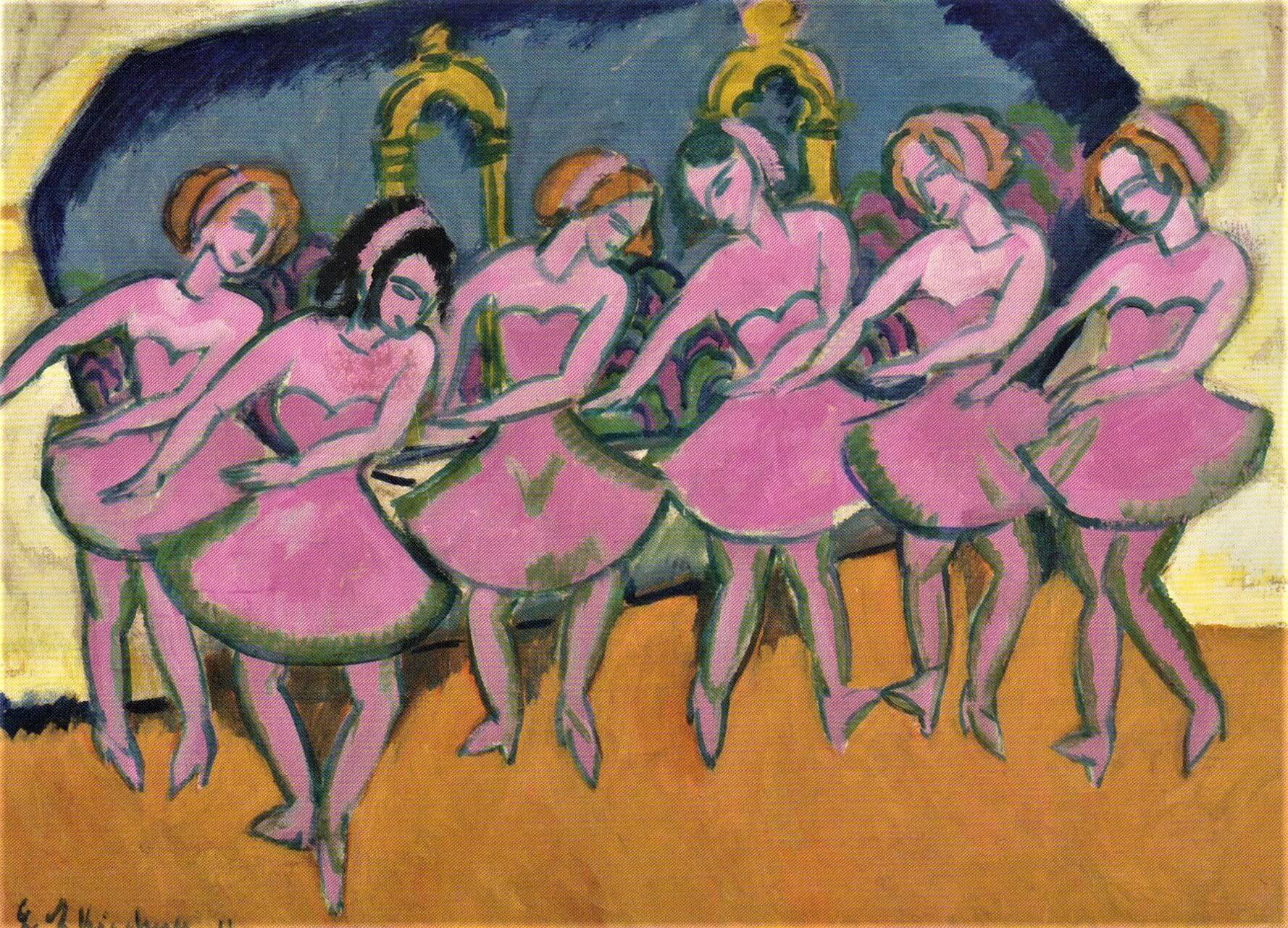
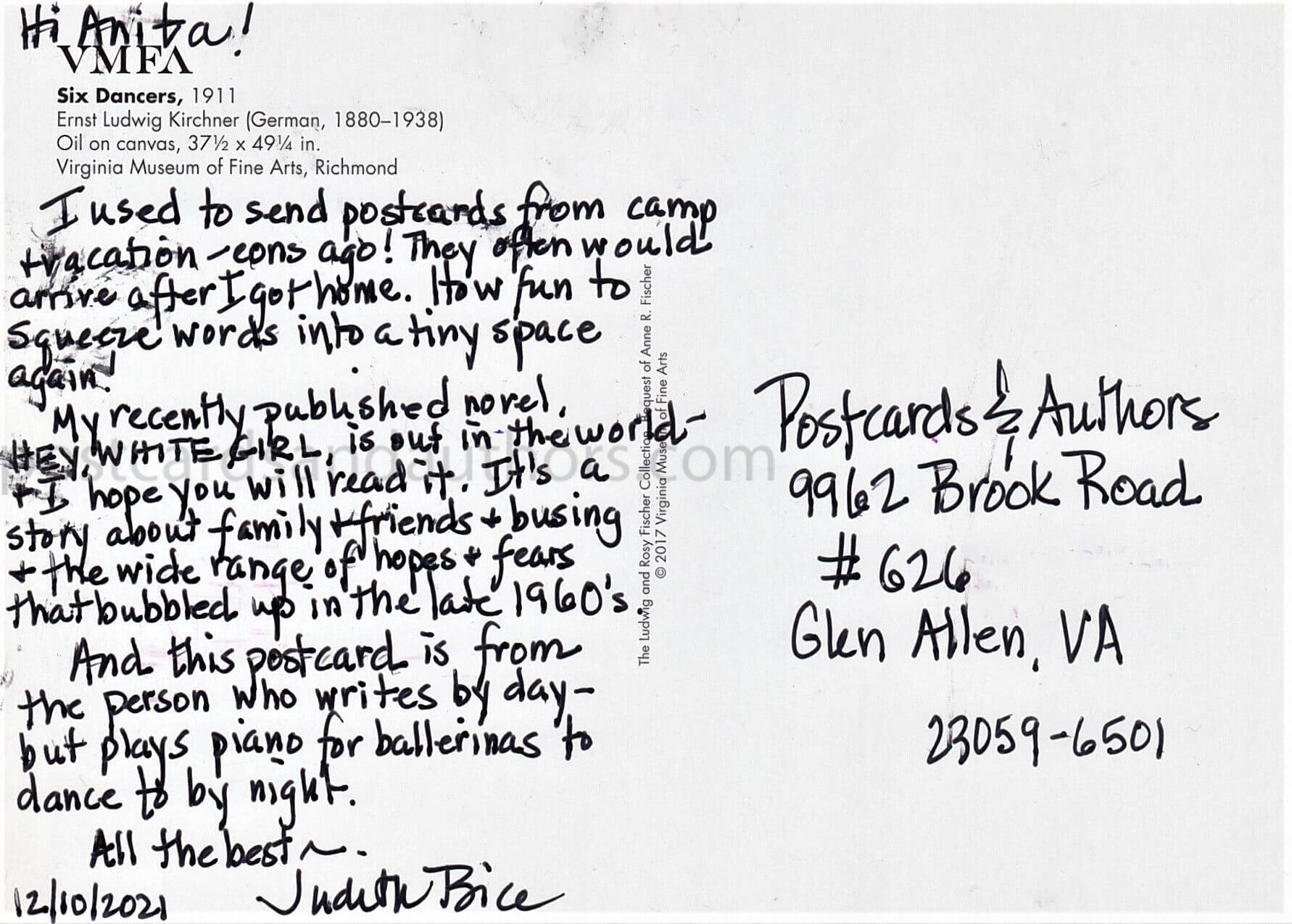
Judith, thank you for this artsy postcard from our beloved Virginia Museum of Fine Arts (VMFA to the locals). It\’s a perfect selection to represent your talent and love of playing piano for performing ballerinas. I hope you have more of the same postcard to send to others and that you\’ve resumed the art of writing postcards from your childhood vacation and camp days.
Reading Hey, White Girl was a pleasure. I hope others will read it too. 🙂